|
In the late 1930s, the Japanese
Naval Staff began development of a long-range escort fighter to provide
protection for Mitsubishi G3M (Nell) bombers, which were suffering heavy losses
in China. Similar in concept to the Messerschmitt Bf110 and Potez 630, the
13-Shi specification issued in 1938 called for a twin-engined, three-seat
fighter with heavy armament, long range, and speed and maneuverability
comparable with the A6M Zero. In response to the specification, Nakajima
designed the “13-Shi Twin-engine Land-based fighter”, which received the
short designation J1N1. A feature of this aircraft was a pair of remotely
controlled turrets on top of the rear fuselage, each containing a pair of 7.7mm
machine guns. Unfortunately, the weight and location of the turrets affected
stability and the turrets themselves were complex and prone to breakdown,
resulting in the rejection of the aircraft in the long-range fighter role.
However, the J1N1 had some positive features and it was decided to produce the
aircraft as a fast land-based long-range reconnaissance aircraft under the
designation J1N1-R. The troublesome dorsal turrets were removed and faired over,
resulting in a humped back appearance to the rear fuselage.
In early 1943, Japanese airbases
in the Pacific were suffering from nighttime raids from US B-17s, for which they
had no defense. Commander Yasuna Kozono, commanding officer of the 251st Kokutai
based at Rabul, suggested placing obliquely mounted 20mm cannon in the observer’s
cockpit of the J1N1 and using the aircraft in the night fighter role. The
effectiveness of the design was confirmed when a B-17 was destroyed during the
first nighttime combat. Eventually, almost all of the J1N1 and J1N1-Rs were
converted into J1N1-S Type 11 Gekko night fighters. Others were built from
scratch, although these aircraft dispensed with the humpback fuselage, instead
having a continuous line from the rear of the canopy to the tail.
In addition to the changes in the
upper fuselage, other modifications were seen over the production of the Irving.
Initial armament consisted of two upward firing 20mm cannon and a second pair
firing downward. The lower pair of cannon were rarely used and were soon deleted
on later versions of the aircraft. Eventually, a third upward firing 20mm cannon
was added to late aircraft. The J1N1-Sa (Type 11 Gekko Ko) had a modified
exhaust where the original exhaust collector system which discharged over the
top of the wing was replaced with individual exhaust stacks. Most Gekkos had a
clear nose cap, behind which was a small searchlight, although a few were fitted
with a solid nose with antennas for AI radar. Unfortunately, the radar was heavy
and had limited performance that prevented its widespread adoption and many
aircraft fitted with the radar had it removed.
During World War II, Japan lagged
behind other nations in night fighting and the Irving was the only aircraft for
this purpose produced in Japan. The aircraft was effective against nocturnal
B-17s and B-24s, but was less successful against the fast B-29 bombers, seldom
being able to make more than one firing pass before falling back out of range.
Production of the J1N1 series ended in late 1944 and near the end many surviving
Gekkos were expended in kamikaze attacks carrying two 250kg bombs under the
wings.
The Kit
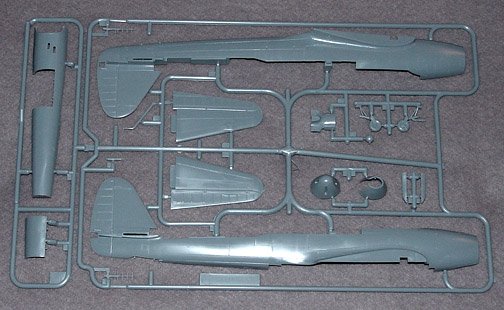
What can one say about the kit
other than it is a typical new Tamiya kit. That means fine recessed detail, good
interior detail, and good fit.
| The cockpit is
pretty well detailed, as is the cannon bay which may be seen if the
separate access hatch is displayed open. |
|
|
|
| Two canopies are
provided, one closed and the other with the hatches separate so they can
be displayed open. |
|
|
|
| Optional stores
consist of 300-liter drop tanks and 250kg bombs. No separate flaps this
time around. |
|
|
|
| The entire lower
wing is one-piece with the wheel wells molded in, ensuring proper dihedral
and avoiding the seam that was present in their Dinah kit. |
|
|
|
| One possible
annoyance is that Tamiya not only molded the tailwheel to its strut, but
the whole assembly is split into two halves resulting in a seam all the
way around. Built according to instructions, you get an Irving with the
two-cannon upper armament, glass nose with searchlight, and collective
exhaust. |
|
| The
parts breakdown suggests that other versions are forthcoming from Tamiya.
The upper rear fuselage is provided as a separate part on a gated subsprue
off of the fuselage sprue, making the humpback Gekko resulting from the
conversion of J1N1 and J1N1-R airframes a possibility by replacing this
subsprue. It also appears that the three-gun upper armament version would
merely require replacing the gun bay hatch, as it appears that the third
gun projected through this panel, and modifying the gun mount.
|
| Finally,
the forward part of the engine nacelles, which have the troughs for the
collective exhaust system, and the exhaust parts themselves are on a
separate sprue, so the later individual exhaust system could be
accommodated by merely replacing this sprue.
|
|
|
There are also some extra
parts in the box, marked not for use, which allow other versions to be
built OOTB. You get a total of 4 cannon and there are two flashed over
holes in the rear of the lower wing part, so one could easily add the two
lower oblique cannon. However, the lower armament seems to mainly be a
feature of the humpbacks and may not be correct for this kit. You also get
a second solid nose and 4 radar antenna allowing the AI equipped version
to also be easily made.
|
| Decals are
typical thick Tamiya and provide markings for two aircraft in overall dark
green, one a B-29 killer from the 302nd Navel Fighter group. Generic
numbers are also provided for other 302nd NFG aircraft. |
|
Many Tamiya kits include a
supplemental instruction sheet, which contains a detail vehicle history and a
number of line drawings showing important details. Normally this information is
only in Japanese, but the sheet in this kit contains an English version on the
opposite side of the page. Hopefully Tamiya will continue this trend in the
future, as there is some good information here.
Overall, another winner from
Tamiya.
References
Japanese aircraft of the
Pacific War by Rene J Francillon
Dave Williams
|
|