|
Under
Project Northscope (Later Commando Nail), in approximately March of
1967 a small number of around 13 F-105F's that had originally been
modified to Wild Weasel EF-105F's in 1966, were further upgraded with
an improved/tweaked R-14A NASARR radar that allowed for sharper target
definition on the rear-seaters radar scope and also provided for a limited early
low-level terrain avoidance capability. Additionally, the weapons
release system was modified to allow the rear-seater to control bomb
release and special lighting was added to both cockpits. This was
the USAF response to the success of the all weather/night attack
capability that the Navy was enjoying with the A-6A Intruder starting
in 1965. Originally this had started for the USAF with F-105's
flying sorties with EB-66 Destroyers that acted as pathfinders using
the Destroyer's K-5 radar bombing navigation system to guide the Thuds to
their target and then signalling them for bomb release. It was then
later realized that the Thud's own radar and bombing computer could be
used in conjunction to achieve the same results and these aircraft would
be sent out on low-level, night-time, single plane raids on targets deep
within North Vietnam. These aircraft were assigned to the 44th TFS
at Korat Royal Thai Air Force Base and the crews (who had been
specifically selected by PACAF Commander, General John Ryan), became known
as "Ryan's Raiders." To help camouflage the aircraft at
night from below, they had their light gray undersurfaces overpainted with
the upper surface tan and SAC Bomber Green. Since these aircraft
were still being used in both their original bombing and Wild Weasel
rolls during the daytime, ground crews were hard-pressed to have them
turned around and ready for their night-time raids as well.
Throughout
the first Rolling Thunder bombing campaign, Northscope crews had
flown around 415 sorties on a near nightly basis, but bomb damage
assessment was limited, as many of the targets were also hit during
daytime raids (sometimes on multiple attempts), so it was hard to gauge
success of the concept since it was not known under which raids the damage
was caused. At least 3-4 of these aircraft were lost on these
night-time raids and it would seem that overall it was not deemed
as a huge success. But through this program, tactics were
developed for what was believed to be the impending deployment of the
B-58 Hustler to Southeast Asia to do the same mission (which lead to the
urban legend of a B-58 painted similarly to the B-52D camo at
the time). We now know that this was not to be, but what
was learned was rolled over to the F-111A program and its first deployment
to Southeast Asia in Project Combat Lancer/Harvest Reaper and the USAF
finally had it's all-weather/night attack capability (even if it did go
through it's own growing pains... but that's another story).
Click on
images below to see larger images
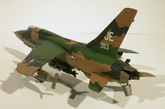
I
utilized the excellent Monogram 1/72 F-105G Wild Weasel kit (which was a
pretty trouble free build) and back-dated it to EF-105F standard by
leaving off the ALQ-105 pods on the sides of the fuselage and
removing the ALR-31 antennas on the wing-tips and the G-specific wing-tip
lights that protrude from the front of the wing-tips.
The
gun-gas purge vents on the right side of the nose were filled in as they
do not appear in the reference photo I have of this aircraft. I did
not fill in the left side purge vents since the Thud fleet started
receiving these right around the time that the Raiders were
flying their missions, so I'm going to assume that they had them. I
also removed the scabbed on reinforcing plates on the top and bottom of
the wings since this appears to be a post-Vietnam modification. All
other raised panel detail was sanded smooth and I only rescribed certain
panels and antennas that would help with painting later.
The
wing tanks, center-line MER with bombs and outer weapons pylons came from
one of Revell's F-105D kits since Monogram did not include these with
their G-kit. The twin AIM-9B launch rails were scratch-built to
match pictures of this set-up seen on Thuds and I went with the AIM-9B as
part of the load-out, as fellow ARC forum member ThudDriver stated that he
had seen in a report where the Ryan's Raiders crews used these to suppress
North Vietnamese search lights at night, as they would apparently home in
on the heat given off by the lights. Seems like a pretty good use
for this variant of the AIM-9 since I've heard that they were about as
useless as a fire-cracker for much of anything air-air. The AIM-9's
and the ALQ-87 ECM pod came from Hasegawa weapons sets.
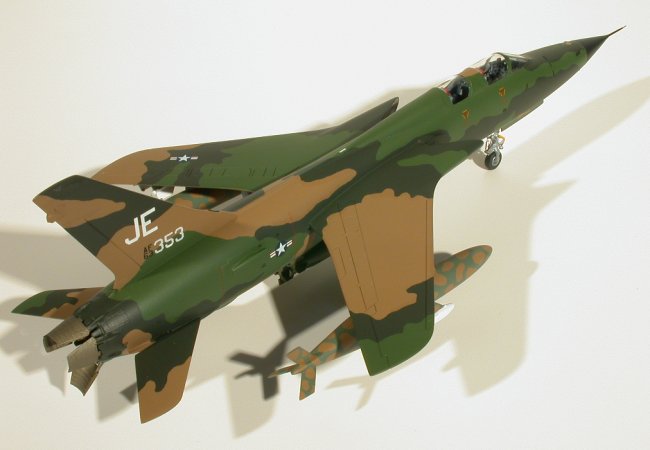
I've
always found the wrap-around paint scheme and the use of SAC Bomber Green for
the undersurface colors on these birds to be really intriguing and always wanted
to build one of them, but information on specific aircraft and other details of
this mission are fairly scarce and it wasn't until recently that I felt I had
enough information to pick an aircraft to model. I ended up deciding on
aircraft 63-8353 that was known as "Whar's Dem Migs??" while it was
flying the Raider mission. It was lost over Route Pack 1 on July 15, 1968,
with Major Gobel James ejecting to become a POW and Captain L.E. Martin being
killed in action. It was also known as "Billie
Fern/Thunderchief" in service. Not sure if it was still doing the
Raiders mission at the time of its loss though... as it's been said that these
aircraft were returned to their normal configuration by the end of 1967.
The
camo pattern on this aircraft appeared to be a 'reverse' pattern similar to the
standard Thud camo, except that it has the Medium Green and the Tan reversed in
the pattern... although it's obvious in the right side photo of this aircraft
that the pattern on the right side of the nose was decidedly non-standard... so
I don't know about the rest of the aircraft, but the vertical stab looks
to be standard and there were other Thuds that were done in this 'reverse' style
pattern at the time, so I took a few liberties with the upper surface camo
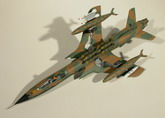
pattern. The underside pattern is a complete guess considering the
rarity of photos of these aircraft. The fuel tanks and the wing pylons
were splotched in Tan and SAC Bomber Green per a couple of profiles in two
different references, but I have not seen photographic evidence to verify
this though.
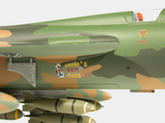
It
took me a while to figure out the tail-number to match the art-work underneath
the intakes, as I had a nost-art book that had a really excellent photo of the
art-work, but did not identify the specific aircraft anymore than to say that it
was a "Ryan's Raiders" aircraft (Some references just really leave a
lot to be desired at times!) One day while looking at a well-known photo
of aircraft 353 I made a realization that there was art-work underneath the
intake and it was pretty obvious (with the help of a magnifying glass) to see
that it was the art-work for "Whar's Dem Migs??"
Seeing
that these markings have never been done in 1/72 scale (that I'm aware of... but
it was available for you 1/48 builders from Aeromaster a while back - but be
cautious with Aeromasters camo painting guide, as the right side is definitely
wrong in their instructions)... I scanned in the photo I had of the art-work and
proceeded to color it in so that it didn't look so much like a photo when I
lazer-printed it. I also matched the surrounding colors as best as I could
so that I could print this on white decal paper and try to blend in the paints
with the decal as much as possible. Not perfect by any means (as you'll be
able to tell from the close-up I've included), but I wasn't left with much
alternative. I've also included this art-work on the left side of the
aircraft as well, as I don't have any confirmation either way of whether it was
carried there or not.
Click on
images below to see larger images
The
white serial number and identification letters on the vertical stab were done
with Woodland Scenics 45-degree Gothic dry transfer letters and numbers.
The black letters/numbers on the vertical stab and on the yellow radar reflector
on the nose gear were done on my lazer printer.
Thud
specific stencils came from several Thud decal sheets from several different
manufacturers that I have in my stash.
Additional
blade antennas made out of thin strips of Evergreen styrene were added to the
underside of the fuselage behind the nose-gear bay and with that the kit was
pretty much finished and adds another mighty Thud to my finished collection!
Respects
to the Raiders crews as they truly had solid-brass cajones to fly these missions
with the technology available to them at the time and were trail-blazers for the
F-111 program that followed!
J.C.
|