|
The A6M Reisen (Zero)
fighter is without question the most famous Japanese aircraft of the Second
World War. However, few people know that small numbers of the Zero were equipped
with an oblique cannon, to help defend the Japanese home islands.
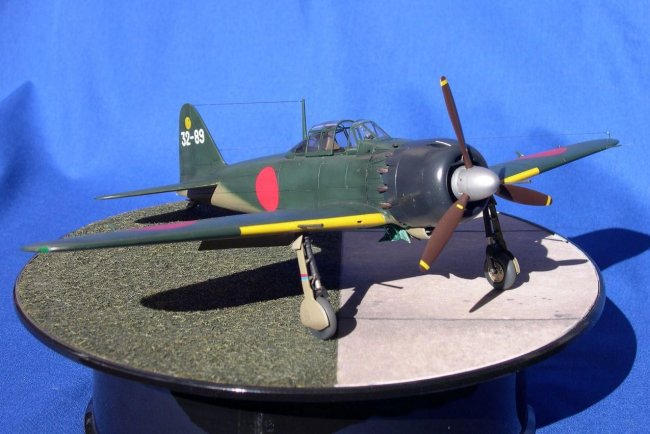
This second
installment of my Japanese nightfighter series features just such an aircraft.
Known units that flew this variation of the Reisen include the Atsugi based 302nd
Kokutai (who specialized in oblique armed fighters), as well as the 332nd
Kokutai based at Iwakuni. My model represents an aircraft from the 332nd,
and was operational in early 1945. Being that the oblique cannon was field
mounted, it is possible that members of the Atsugi based 302nd
Kokutai helped with the installation of the gun in this aircraft. For a short
history of Japanese use of oblique cannons, please see my previous article here
at ARC, documenting a nightfighting Suisei.
THE
MODEL
For this project, I
used the 1/48 Hasegawa kit, stock # 09543. Released in March 2004, this kit
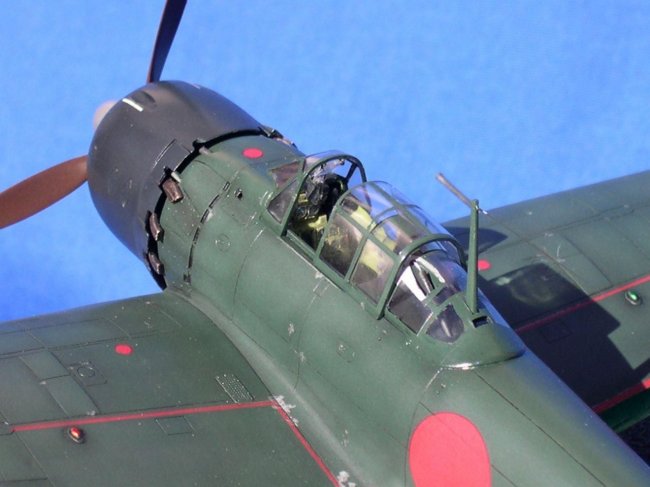
differs from the basic A6M5 Model 52 in having parts for the 20mm oblique
cannon, unique windscreen mounted gunsight for this weapon, as well as the
modified rear canopy section which housed the cannon.
For
anyone who has built a new generation 1/48 Hasegawa A6M5, there are no surprises
here. Detail is above average but not exceptional, you need to watch how you
assemble the wing/fuselage join, plus some small parts were fiddly to work with.
Additional detail on this model includes brake lines, a scale thickness splitter
added to the oil cooler intake below the cowl, plus a photo etched harness from
Eduard. I also discarded the kit supplied oblique cannon and gunsight, and went
with replacement parts.
Like the basic Model
52 kit, this version offers the ability to model either a basic A6M5, or an
A6M5a. The major external difference between the two versions was wing armament,
and associated wing panels, which are supplied as insert parts. Hasegawa will
have you build all three markings options as A6M5a, however, careful study of
available photos show the Atsugi based nightfighters were actually basic A6M5
versions. Since the one clear photo of 32-89 did not reveal any evidence as to
which version it was, I chose to model it as an A6M5 as well.
One other small point
is the rear canopy glass. Being these aircraft were field modified, there were
some very minor differences in frame layout, and how the cannon mounting plate
was installed. The part supplied by Hasegawa is similar to all the aircraft I
studied, yet somehow does not accurately recreate any of them! This was a
perfect opportunity to use the “close enough” philosophy, and move on……
|
Click on
images below to see larger images
|
|
|
Similar to my nightfighter Suisei (Judy), I used Tamiya acrylics and Gunze
lacquer paints for this project. This Zero was built by Nakajima, so I went with
the colors most often found on Nakajima built Zero relics today. The cockpit
color is FS 34258, and for this I used a mix of Tamiya XF-71, 2, and 3. Gunze
Mr. Color #15 is a great match for dark green FS 24077, and for the lower
surfaces I used a mix of Tamiya XF-20 and 49 to replicate FS 24201. Cloth
surfaces on the lower side of the wings and elevators were sprayed with a mix of
Tamiya XF-25 and 2, which is close to FS 16314. The cowl is Mr. Color #125, prop
Mr. Color #131, and the area under the windshield/behind the cockpit is Tamiya
XF-69. Wing leading edge IFF stripes are a mix of Tamiya yellow and red, and
finally, the flap and gear door interiors are my personal mix of Aotake, Tamiya
clear green and blue with a touch of silver for some opacity. Clear coat is the
Gunze series of lacquer clear coats, which I mixed for different sheens on the
airframe.
Markings came from
both the kit decal sheet, as well as the wonderful sheet from Revi, #48002
“Japanese Schragemusik”. A subtle oil wash, and airbrushing some ground
color up onto the gear doors is about the extent of weathering on this model.
One oddity arose while
studying the photo of 32-89 I had access to, and that was what seemed to be an
extra aerial that ran from the vertical stabilizer, to some point out of the
photo. Using scale drawings and the little bit of mathematical knowledge left in
my 37 year old brain, I decided that this aerial would have stretched to the
wingtip. Model 52 ailerons ran almost to the tip of the trailing edge, so I used
some imagination and installed a post made from thin brass wire. Is this
accurate? Will we ever know for sure…probably not.
While there are almost
countless references on the Zero itself, data on the nightfighters is scarce.
The best source of photos for these rare birds is Koku Fan #96, covering the 302nd
Kokutai. Great general Reisen reference books include Illustrated Zero Fighter,
published by Green Arrow, the Aero Detail volume, Model Art #510 on IJN
fighters, as well as the various Famous Aircraft of the World books. If I
omitted any, it is for sake of brevity! Finally, a search of the FAQ at J-aircraft.com
will answer almost any question on the Zero, be it on color, source of
manufacture, type identification, etc.
This project took me a
month from start to finish, and was helped by my using some previously painted
parts from a project I had given up on. The 1/48 Hasegawa Zero kits are a fine
way for somebody interested in WWII Japanese aircraft to get their feet wet, and
build into fine replicas. Only problem is, which one to build next?
Dan
|
|