1/72 Hasegawa I.A.I. Kfir C2 |
|
|
Gallery Article by Albert Moore
on May 6 2003 |
|
|
 Israel Independence Day
|
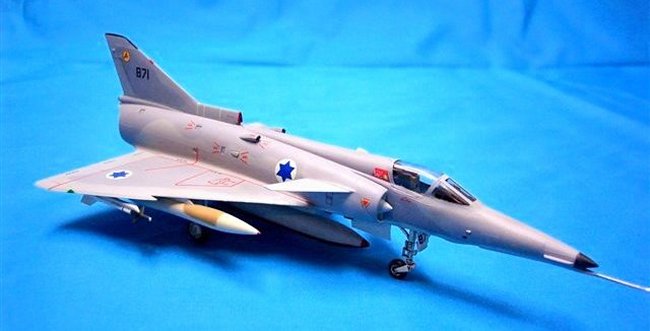
Able
to perform the multi-mission tasks required of today’s air forces, the IAI
Kfir (Young Lion) has been an integral part of the Israeli Air Force’s air
campaigns dating back to the late 70’s.
As a result of the 1967 Six Days War,
France
levied a military embargo against
Israel
,
which effectively cancelled an order for 50 French made Dassault Mirage V
fighter aircraft
Israel
had placed prior to the start of hostilities.
Out of necessity due to attrition from the Six Days War, Israel
Aircraft Industries started manufacturing their own unlicensed copies of the
Mirage V (called the Nesher in the Israeli Air Force).
At this point, the
United
States
had become
Israel
’s
main supplier of military aircraft. Starting
with the purchase of A-4H Skyhawks,
Israel
also acquired the mighty McDonnell Douglas F-4E Phantom II.
In addition to F-4 airframes,
Israel
also received spare General Electric J79 jet engines (which powered the F-4E).
IAI took a Nesher, and mated it with the J79 engine. After
some tweaking, the re-engined Nesher was renamed the Kfir.
Later improvements for the Kfir included adding forward canards to
improve agility and low speed performance, as well as a state-of-the-art
avionics suite. In front of a
large audience, I.A.I. revealed the Kfir to the public in May of 1975.
The Kfir has also been exported to
Ecuador
,
Columbia
,
and
Sri
Lanka
.
The US Navy leased two squadrons of Kfirs for use as “aggressor”
aircraft for DACT exercises. With
the Lockheed-Martin F-16 becoming the main workhorse of the IAF in the last 15
or so years, the Kfir has been withdrawn from service and placed in
operational storage.
|
Click on
images below to see larger images
|
|
|
Hasegawa’s
Kfir-C2 has been around for quite a while now, and currently retails for around
ten bucks. Molded in light gray
styrene, the kit contains 55 parts on the three sprues (1 clear sprue as well).
The instructions are easy to follow and have color call-outs for most of
the parts. Decal options are for
two aircraft: a desert camouflaged Kfir with the 101 (First Fighters) Squadron,
and a Ghost-Gray Kfir of the “Guardians of the Arava” Squadron.
The cockpit is very basic, consisting of the bucket, ejection seat,
control stick, and a flat panel to put the instrument cluster decal over.
The overall fit is hit and miss, but nothing the average modeler can’t
handle. The trickier items to deal
with are the air intakes, and where the bottom of the delta wing mates up with
the fuselage. Again, sanding and
some filler will resolve these issues. The rest of kit pretty much falls
together. The panel lines are
of the raised type, so care will be needed in regards to eliminating seams.
Typical of Hasegawa, there are no air-to-ground munitions, just two
sidewinder missiles and three external fuel tanks.
If you want things that go BOOM!, you’ll to have raid the parts bin or
spend more money on a Hasegawa Weapons Set.
For a different missile set-up, you can substitute the sidewinders with
Python 3 air-to-air missiles from a resin supplier or, make your own.
The decals are typical Hasegawa as well.
They are a little on the thick side and some what translucent, especially
where the Star of David roundel lays over the yellow and black ID panels for the
wings (for the desert camo. version). Also,
they don’t respond worth a damn to setting solutions, as they tend to roll
onto themselves and shrivel (they seem to do just fine with warm water alone, so
no solutions are really necessary). The
instructions lack the FS color codes for the all gray scheme, but tell you the
mixing ratios using Gunze paints (the colors are Light Ghost Gray (36375), Dark
Ghost Gray (36320). The
instructions list a third shade (Light Gray 36495), though most Gray Kfirs were
finished in just the two grays listed above (which I found out after I painted
my model...oh well).