|
Emails from around the globe, which I did not expect. Best I show you a
map, so you can see where Akron, Ohio U.S.A. is. Akron, in its'
"hayday," was the Rubber CapitaI of the world. I grew up
in Portage Lakes, which was about 7-miles from G.A.C. Living in the
country, it was very quite, but when they test-fired those 6-machine gun's
on the mighty Corsair, we could hear them loud, and clear. If I shut
my eyes, and go back to the 1940's, I can still hear them today !
Joe Hegedus, one of many F2G Corsair friends located the original drawings of
the F2G. I was surprised, when he sent me these copies. They were on
micro-film. Nick raised hell with me about the "F2G-1D," and
said they never made any. Yet! the call letters are on the factory drawing
! Years ago, I drew a drawing, showing the different style of Corsair
canopies, including the F2G. When I wrote to people, and included the
drawing, they knew what I meant by "canopy-tip." I had no idea
what G.A.C. called it !
Several years ago, Al Keller of
Uniontown, Ohio; (East of Akron) sent me some copy negatives. Al said Nick
gave him several 8"x10" prints to photo copy. Here are some rare
factory prints. I have a couple of these in a previous review, but here
they are, all grouped together.
B.U. # 02460 may have been the first F4U-1 "Birdcage" Corsair to have
the big R-4360 engine on it, so say's the historians. I have two separate
"Birdcage" photos, with the R-4360 engine, and the paint on the right
sides do not match up !! Were there two such aircraft used?
B. U. #14091, and #14092, were addition's to the Corsair program. They cut
down the rear deck, added the P-47 Thunderbolt canopy, ( which came from the
British Hawker "Typhoon," so said a historian ! ) My
father Harry said that they tried several things, in order to get the new
Corsair's into production "fast." However, the end result was a
completely re-designed canopy, maybe windscreen too. The windscreen looks
similar to the one's they used on the P-38J, and on the F4U-4. The
haunting question is ? Did the Typhoon canopy mate up with the F4U-4
and/or P-38 windscreen? Nick's spread-sheet says: 091 had a
production No. of 1100, & 092 was 1101. He listed them as XF2G-1's.
Were they F4U-1's or F4U-4's ? He said that they applied a new
windscreen about 8" forward of the existing w/screen and flared it in !
By the way, all Corsairs which were made by Goodyear Aircraft Corporation;
(G.A.C.) were assigned "FG"= Fighter-Goodyear.
Production number 480/ #13471 and 481/#13472 were FG-1A /XF2G-1. They were
fitted with the big engine, and a 4-blade prop. A blue number
"5" was painted on both sides of the Goodyear Chrome Yellow cowling,
which was B.U. #13471. Nick said they were both scrapped. Nick
also said that No. 5 went to the A.&E. school in Tennessee. A Navy man
and Corsair "buff" was at the school from 1945 -1955. He wrote
to me a few years ago, and said he never saw any kind of Corsair at the school
with the big engine, and a #5 on the cowling.
I call these two ships, "The Mystery - Ships." We have looked
for their records, but can not find a B.U. Number for either "I-36 and
C-51." We know that two F2G' s served with the fleet. They say
both of the bird's went to San Diego, CA. There is no B.U. Number ending
in 36, nor 51 ! They list these two aircraft as F2G-2's. The numbers
are #88461 & #88462. They both were stricken from the Navy records in
1947, and presumed scrapped ! Got any answer anyone ?
Don Armstrong was the main test-pilot @ G.A.C. He would not fly a plane
unless it had a checker board on it somewhere. (Good-Luck, they call it in the
U.S.) I knew a guy who carried around a rabbits-foot in his pocket
for "good-luck." A P-51 fighter pilot carried his rabbit foot
with him in combat. He was killed on Christmas Day, 1944. The Rabbit
had four of them, and it never gave him "good-luck." Art Chapman
was another G.A.C. test pilot.
B.U. # 14691, was the 3rd XF2G-1. Vought supplied many parts to G.A.C, and
they were painted gloss sea-blue. Sitting on the tarmac,one can see that the
fuselage was painted with the lemon-green chromate color. Later she was
topped-off with the sea-blue, and a yellow chrome cowling, with a sea blue #9
painted on both sides of the cowling. If you build this model, don't
forget to offset the fuselage insignia on the left side. Nick said
#9 did not have any machine guns installed ! Why is the paint burned
off around the gun openings ? Any pilot knows that a
"test-aircraft" would fly different without the guns. I
read that those .050" cal; guns weighed around 160 pounds each. #9
had 4-guns. Is there any pilot out there that can answer this question ?
By the way, look close at the front of the F2G's ! Some had 3-gun's, while
other's had only two. The late Harry Doan, who once owned #57, said that
when they took off the skin, from the outer wing panels, they found a 50/55-gal
rubber gas tank in each wing. This is why the outer gun was removed, so
they could fit-in those gas tank's. This is also stated in my maintenance
manual on the F2G.
Nick's records show that #9 crashed at Akron-Canton airport, on December 12,
1945. My Akron/Canton F.A.A. report list no such crash. Nick said it
was "top-secret," that's why it's not in the report. The war was
over in August, 1945. Was it still "top-secret?" A photo
of #9 was printed in our local newspaper; "The Akron Beacon Journal;"
during the winter of 1944/45. How could it be "top-secret?"
I know it was at this time, because the style of number "9" was
changed in the summer of 1945, and outlined in black. Another photo shows #14691
on the tarmac @ N.A.S; Patuxent River, MD; dated 1948. I can read the B.U.
#14691 on my print. If this is truly #9, they must have re-placed the
slanted insignia. What is the correct b.u. number for #9?
We know that #14695 crashed at Akron, and was painted yellow-green on the
fuselage, with flying surfaces in sea blue. Nick sent me the two prints of
a F2G setting on the tarmac @ G.A.C. He gave a b.u. number of 14691.
Could it really have been #14695 ? So much for history !
B.U. #88454 is listed as a F2G-1, yet it has folding wings. The F2G-1's
were to have a non folding wing, while the F2G-2's had the folding wings. In
1987, while on vacation in Portage Lakes, I spoke to John Anderson, who was an
engineer @ G.A.C. I ask about the folding wings. Johnny said that as
far as he could remember, all the F2G's had hydraulic folding wings. He
also stated that if they had got into production, yes some would retain the
hydraulics', and some would be made for the Marines, without it, or a so-called
"rigid one piece wing." I ask Johnny how would they do that ?
His reply was" "Guess they would not install the hydraulics,' and just
bolt the outer wing panel onto the inner section."
John said: Rodney: "That's my best answer, as it has been over
40-years. I'm in my '70's now, and the memory is not all that good.
But I do remember your dad "Harry," and you."
When #88454 was at Akron, they painted 454 on the cowling. Note,
that it's void of the auxillary rudder. An auxillary rudder was
retrofitted to all F2G's, to control the excess torque of the big engine.
This rudder was 11-½" high, not 12" as some books say. Nick
said that when the flaps were lowered below 30 degrees, the auxillary rudder
moved to the right by about 12-degrees.
The photo's, show that #88454 was stored in a container. It was
found by Capt. Walt Ohlrich during the 1960's. When the Navy found out
that Walt was going to race it, they took it back. The Navy gave it to the
Marines. Doug Champlin traded a Douglas Dauntless dive bomber for the F2G.
When Doug Champlin moved his museum from Oklahoma to Arizona, none other than
Ron Puckett, the one time owner of racer #18, flew the aircraft to its'
new location. Notice the cockpit photo's, and the rear deck. Note
also the canopy's cross-over bar. The canopy roll bars, armor plate, and
headrest was removed before Doug got it. Doug told me that they never
re-painted the insides, so you can see the original lemon-green paint.
Too top it off, and round it out, how about a "BUD" ? YES!
YES! YES! This BUD made some records at the Reno Races, before she crashed
in Southern, California a few years ago. The plane caught on fire, the
pilot bailed out and lived to fly again. The BUD dug a hole in the ground,
a "total" loss !
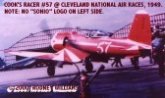
Why not a few more photo's of my "dream-machine," yeah #57. Some
you have seen in another part of the story---BUT---!! Keith Bunyan of New
Zealand was at the Oshkosh, WI "Fly-In" this year. He sent me a
photo he took, while #57 was flying. Thanks Keith for letting me use the
photo in my story.
What did Goodyear Chrome Yellow look like? Here's a copy from a 1990's
brochure, showing the yellow on one of their blimps. Is it the same color they
used in the 1940's?
To all you P-51 Mustang and F8F Bearcat people, just remember: The Corsair
was the first aircraft to reach speeds over 400 miles per hour. The
Corsair was produced longer than any other piston engine a./c.
If we could have a race today between a F2G, A Mustang, and a Bearcat, you know
darn well the F2G would take first place, "JUST LIKE IN THE 1940'S."
For a treat, here are a few Corsair bird's from my World War-II
"Scrapbook."
Oh but YES !! I have won a couple of AWARDS.
And let us not forget that Cook Cleland won a race in 1946 with his "Lucky
Gallon," a FG-1D; B.U. #13481.
How many planes were involved in the F2G program ? I list 28 aircraft !
OOPS! It's 29. I forgot to add the one Nick listed.
Jim Butler List: No.'s 12992; 13471; 13472; 14691; 14692; 14693;
14694; 14695; 88454; 88455; 88456; 88457; 88459; 88460; 88461; 88462; &
88463.
My List: No's 14091; 14092; & 88458; (#57 racer)
A recent (1994) "F4U Corsair," book listed the additional aircraft:
#02312; 02460; 13007; 13703; 13704; 13373; 14064. The book said a FG-1 was
given to the British. Its' number was "KD554." I did a
little calculation, and came up with B.U. #14885 for this FG-1. Really can't say
I'm right on this one!
Nick listed 20-aircraft on his "spread sheet," which matches Jim &
my list. He entered one more a./c. to the program. Its' B.U. number
is: 13374, with a production number of 383. It is listed as a FG-1A.
The cowling was painted yellow, with a black number " 3 "
painted on it.
I've mentioned many peoples names, who have helped me on this program.
I'll list a few rare books I found over the past 15-years. Air Classics;
(A.C.) October, 1970; Vol.7 No.1. story "Too Late For Glory."
F2G's @ Cleveland races. A.C.-April-'72 same story with different photo's.
A.C.-October-'72, Vol 8, #12. "The Wildest Air Race,"
Cleveland, Ohio. Air Progress "Warbirds Int." July/Aug-'89
"Disaster @ the Thompson." Cleveland, Ohio 1947. Many of my race
photo's came from "Racing Planes," and air racers; by Reed Kinert;
Vol-IV; series No. 1. Two of my photo's of 454 painted on the cowling are
from: Profile Publications; The Chance Vought F4U-4 to F4U-7 Corsair; No. 150.
More photo's came from the two Squadron/Signal book's. Numbers; 29 &
145.
Some who have written, ask how I got such an unusual email name. Well it
belongs to my wife of 38-years.
Some ask : "Are you really quitting modeling Rodney?" When you
look at the photo's of Samoa, pretend that you are 69 years old, & you have
worked for the last 63 years. Is it "TIME?" YES!
YES! YES! After 22-years, of cutting plastic, I'm going to Samoa.
Yes!!!!!! It's back to scuba-diving, and just relaxing on the beautiful beaches
of Samoa. While in Samoa last year, I met some old fart who was 73, and he
still goes diving. If he can do it, I can tooooooooooooo!
Happy Modeling Rodney
Post Script: Did I miss anything, and most of all, did I get it right ?
Well after a 150 hours or so, putting these four parts together, I have no idea.
If I made a mistake, well that's "human-nature." I think, when
time permits, I'll get together Part-V, just a photo session of my 1/32 scale
crashed F2G. Let the 60+ photo's tell the story. I must finish the rest of
the 1/32 scale "Master's" for the F2G. My friends @
"OBSCURECO AIRCRAFT;" 224 WARREN DR; VACAVILLE, CA; 95687; U.S.A;
(408) 723-3995; email:
ObscurAir@aol.com
will produce a resin kit package for the Revelle F4U-1A model. From the
sale of said kits, my commission will keep me in beer money, ($5.00 U.S. per
month) while living in Samoa.
P.S. I am right on most of this information, but, please, if you can give any factual input, please do so.
P.S. Check out some of my other models on www.skywriters.net
|
|